
Imagine you’re interacting with a new yield optimizer on Arbitrum at 2 a.m., gas is low, and the UI promises 10–20% APY after complex vault operations. You click “Approve” and your wallet pops a terse confirmation: contract address, amount, and gas. Most wallets ask for a blind signature here. A single overlooked approval can create a long-lived attack surface. This scenario is exactly where transaction simulation — simulating the exact on-chain effects of a transaction before signing — shifts risk calculus from hope and superstition toward structured decision-making.
In the U.S. market, where regulatory scrutiny and institutional custody options are growing, power users now balance speed with defensible security practices. Rabby Wallet positions itself at that intersection as a non-custodial, multi-chain wallet focused on preventing “blind signing” through pre-transaction simulation and a layered security engine. Below I unpack the mechanism, its practical benefits, the trade-offs compared with common alternatives, known limits, and concrete heuristics you can adopt today.
How transaction simulation works, in operational terms
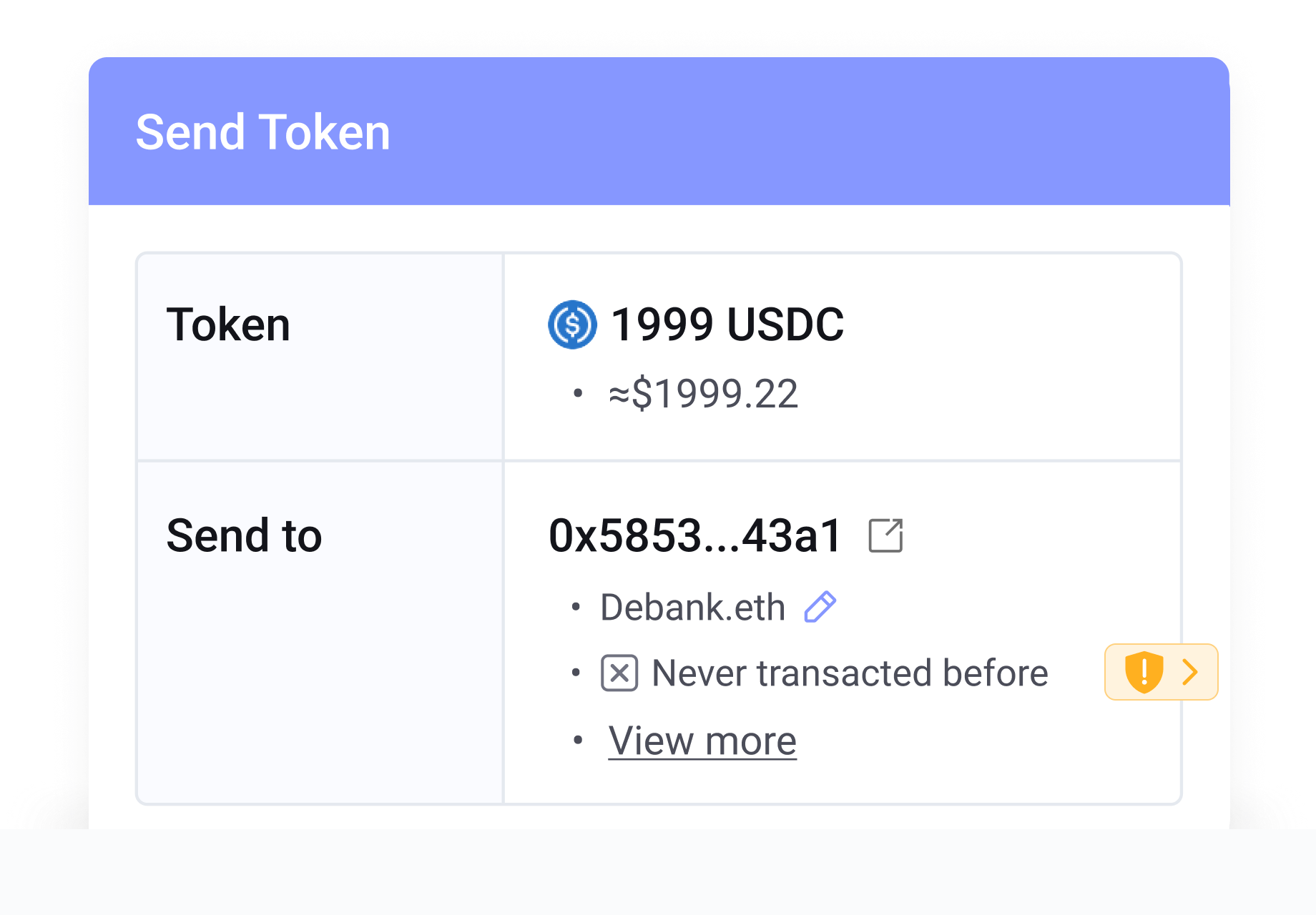
Transaction simulation means executing the intended transaction against a forked or read-only node state before it is actually broadcast. The simulation inspects the exact changes the transaction would make: token balance deltas, allowance updates, expected gas used and fees, and whether the call triggers known risky contract behaviors. Rabby runs this step locally (or through trusted RPC endpoints) and surfaces a human-readable summary: the tokens leaving and arriving, the recipient address, the approval amounts, and the total fees. This is more than a simple gas estimate; it reveals the side effects that blind signing hides.
Mechanistically, simulations do not change the chain — they replay potential state transitions against the current state. That gives users a deterministic preview subject to two boundary conditions: the state can change between simulation and actual broadcast, and contract code can behave non-deterministically if it depends on off-chain or time-based data. Therefore simulation reduces, but does not eliminate, some classes of risk. It is particularly effective at revealing dangerous allowance grants, token swaps with sandwichable slippage, or mistakenly redirected transfers to non-existent addresses.
What simulation buys you — and where it stops
Practically, simulation converts an opaque confirmation dialog into a parsable sentence: “You will send 1,200 DAI, receive 0.5 ETH, pay 0.005 ETH in fees, and grant unlimited allowance to Contract X.” That clarity matters for three reasons. First, it prevents costly mechanical errors (wrong chain, wrong amount, or mistaken recipient). Second, it surfaces malicious or compromised contract behavior before irreversible signing. Third, it supports better operational discipline: you can decide to revoke approvals or route transactions through a multisig after seeing the simulation.
However, simulation has limits. It cannot predict off-chain oracle manipulation or guarantee that the exact simulated outcome will be identical at execution time — miners or MEV bots can reorder or extract value. It also depends on the completeness and correctness of the node and RPC used for simulation; using a compromised RPC could mislead the preview. Rabby’s approach mitigates these through an integrated security engine that flags known hacked contracts and suspicious approvals, but this is still a risk-management layer rather than a proof of elimination.
Rabby’s security stack: simulation plus additional controls
Transaction simulation is one piece of a larger defense-in-depth strategy. Rabby complements simulations with portfolio aggregation, pre-transaction risk scanning that flags previously exploited contracts and unusual approval requests, and a built-in approval revocation tool that lets users cancel active allowances. For institutional users or high-value accounts, Rabby supports integrations with multi-sig and custody systems such as Gnosis Safe and Fireblocks, allowing teams to gate high-risk operations behind multiple signers.
Open-source architecture under the MIT license gives independent auditors and developers access to the code — a transparency advantage that invites scrutiny. Recoverability and hardware wallet integration (Ledger, Trezor, Keystone, and others) add practical layers: simulate on Rabby while signing with a hardware device keeps your keys offline but your preview intact. The wallet also offers automatic network switching so dApps open the correct chain context, which reduces accidental chain-mismatch errors common with single-network wallets.
Comparing alternatives: MetaMask, Trust Wallet, Coinbase Wallet
MetaMask is the dominant interface for many users and offers broad compatibility and developer tooling, but historically lacks built-in transaction simulation presented in a user-friendly way. Trust Wallet and Coinbase Wallet prioritize mobile-first ease-of-use and fiat integration (Coinbase especially), while Rabby deliberately trades off fiat on-ramps and native staking for a deeper security feature set. In short:
– MetaMask: highest ubiquity, rich ecosystem, but requires add-ons or careful UX for advanced pre-signature analysis. – Trust Wallet / Coinbase Wallet: mobile convenience and fiat pathways, but less explicit simulation-first control. – Rabby Wallet: prioritized pre-transaction simulation, approval revocation, multi-chain aggregation, and institutional integrations — fewer fiat rails and no native staking.
Each choice is a trade-off between convenience, auditability, and attack surface. If your focus is defending capital while interacting with complex DeFi logic and multiple EVM chains, Rabby’s simulation-led workflow materially reduces an important class of human error and some exploit vectors.
Corrections to common misconceptions (myth-busting)
Myth 1: “If a wallet shows a simulation, the transaction is safe.” Reality: simulation reduces information asymmetry but cannot prevent MEV, oracle manipulation, or race conditions. Treat simulation as a diagnostic, not a lock.
Myth 2: “Open-source wallets are secure by default.” Reality: open source enables auditing but does not guarantee audits occur or that users run audited builds. Rabby’s MIT license facilitates review, but security still depends on active audits, responsible disclosure programs, and responsive updates (and the team has previously handled a 2022 swap contract exploit transparently, froze the contract, and compensated users — a reminder that operational history matters).
Myth 3: “Automatic network switching removes all chain-choice risk.” Reality: automating network switching reduces user error but increases the importance of the wallet’s detection logic and RPC fidelity. Malicious or misconfigured dApps can still prompt unexpected network prompts; simulation helps, but user vigilance remains necessary.
Decision-useful heuristics for DeFi power users
Adopt these rules-of-thumb when you rely on simulations and a security-first wallet workflow:
– Always review balance deltas and allowance changes, not just amounts and gas. Unlimited allowances are a frequent exploitable pattern. – Use hardware signing for high-value transactions even if the wallet provides a detailed simulation. – For complex batch transactions or vault interactions, simulate on a secondary tool or forked local node if possible to cross-check results. – Integrate approval revocation into monthly housekeeping: scan and revoke stale allowances. – Prefer wallets with open integrations to custody and multisig for institutional operations.
Where Rabby fits in U.S. user workflows and institutional setups
In the U.S., regulatory conversations and compliance expectations push institutions toward auditable control and custody options. Rabby’s support for Fireblocks, Amber, and other enterprise solutions, plus hardware wallet compatibility and multi-sig integrations, make it practical both for sophisticated retail traders and institutions that must show procedural controls. The lack of a built-in fiat on-ramp means Rabby is not a one-stop app for newcomers in the U.S. who need to convert USD into crypto, but it pairs well with on-ramps and custodial services when compliance or fiat needs are in play.
For traders and liquidity managers operating across over 90 EVM chains, Rabby’s cross-chain gas top-up and automatic network switching materially reduce frictions that otherwise cause failed transactions and accidental losses. Those lower-friction features, combined with simulation, change the marginal cost of safe experimentation: you can test more strategies without increasing avoidable mistake risk.
What to watch next (signals that should change your setup)
Monitor three signals that would change how you prioritize wallets: (1) new MEV mitigation or private relay adoption that alters execution certainty; (2) expanded on-chain formal verification tooling integrated into wallet simulations; (3) broader institutional custody integrations that standardize multisig-only flows for high-value accounts. Each would alter the balance between convenience and security in wallet choice and could either amplify the value of simulation or make it one of many redundant safeguards.
For readers who want to test the workflow described here, consider installing a dedicated extension and trying low-value interactions first. If you’d like a focused, security-first extension to experiment with transaction simulation and advanced approval controls, explore the rabby wallet extension as a practical example of the pattern described above.
FAQ
Does transaction simulation prevent all smart contract exploits?
No. Simulation reduces blind signing and reveals many on-chain side effects, but it cannot prevent MEV, oracle manipulation, or exploits that rely on off-chain factors. It is a substantial risk-reduction tool, not an absolute guard.
How reliable are simulation results when gas prices spike or state changes?
Simulations reflect the state at the time of the preview. Rapid state changes, front-running, or miner-executed reordering can alter outcomes. Use simulation as a deterministic preview given current state, and apply additional safeguards (hardware wallets, multisig) for high-value or time-sensitive operations.
Is Rabby suitable for institutional custody?
Rabby integrates with several institutional providers and supports multi-sig flows, making it suitable as part of an institutional stack. Institutions should validate integrations, audit trails, and operational procedures to match compliance needs.
Can simulation detect malicious approvals from phishing dApps?
Yes — simulation will show allowance changes and recipient addresses, which helps detect phishing or malicious approval requests. That said, accurate detection also relies on user attention and the wallet’s database of known-bad contracts.